

Surrogacy has become a promising path to parenthood for many Indian couples facing infertility, repeated IVF setbacks, or medical conditions. With continuous advancements in assisted reproductive technology and clearer legal regulations, surrogacy in India is now a more structured, ethical, and medically supervised journey.
For couples considering this option, understanding the process before taking the next step is essential. This guide explains who can opt for surrogacy in India, the process for surrogacy, and what legal approvals are required. It also covers how IVF with a surrogate works and what factors may influence the overall cost.
What is Surrogacy?
Surrogacy is a fertility treatment where another woman, called the surrogate mother, carries the pregnancy for the intended parents. In India, surrogacy is usually done through gestational surrogacy, where the embryo is created through IVF and transferred into the surrogate mother’s uterus.
This means the surrogate carries the baby but does not contribute her own eggs. The baby is legally intended for the couple or eligible woman who has completed the required medical and legal process.
Who Can Opt for Surrogacy in India?
Surrogacy in India is allowed only when there is a genuine medical need. It is not an open-choice treatment and requires proper approval before the IVF process begins.
In general, surrogacy may be considered for:
- Married Indian couples who meet the prescribed legal age and medical criteria
- Women who cannot safely carry pregnancy due to uterine absence, serious uterine disease, or other medical risks
- Couples with repeated IVF failure, if surrogacy is medically advised and certified
- Eligible widowed or divorced Indian women, as per the legal age and medical conditions
The surrogate mother must also meet specific requirements. She should be a willing, ever-married woman, have a biological child of her own, be medically and psychologically fit, and fall within the legally permitted age bracket.
Commercial surrogacy is not allowed in India. Only altruistic surrogacy is permitted, where the surrogate mother is not paid for carrying the pregnancy, except for approved medical expenses and insurance coverage.
What is the Process of Surrogacy in India?
The process for surrogacy is not limited to IVF alone. Before embryo transfer, couples must complete fertility assessment, legal documentation, surrogate screening, and official approval.
Here is how the procedure of surrogacy in India generally works:
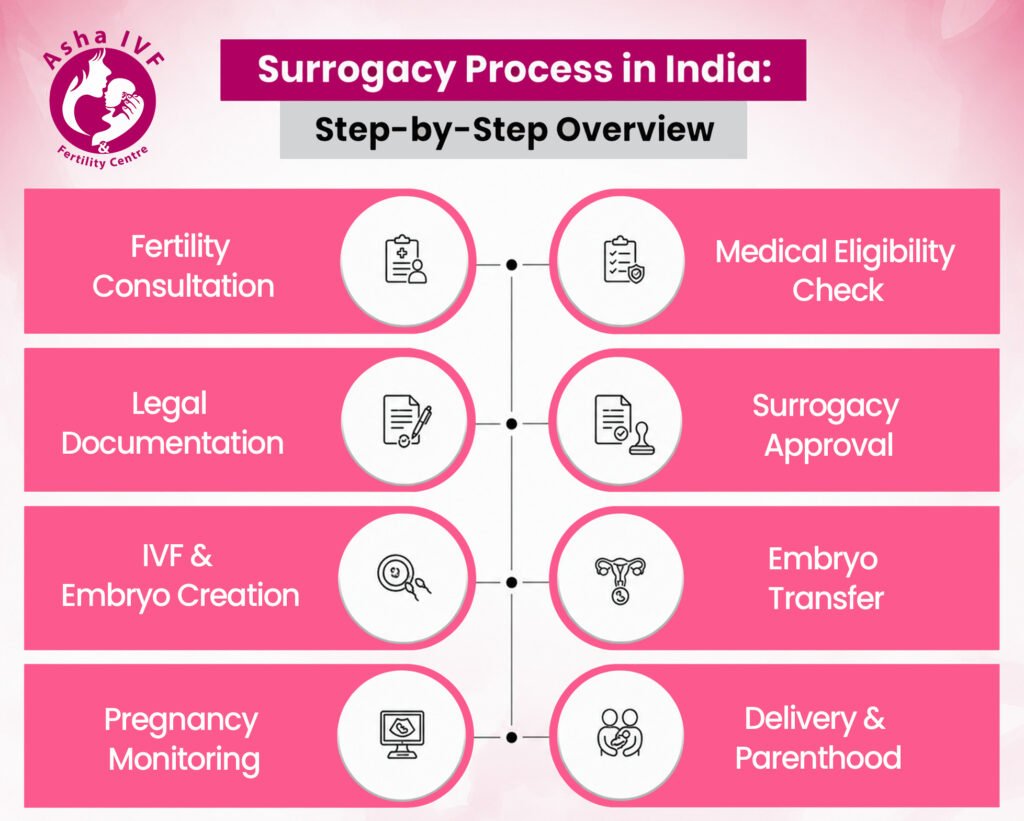
1. Fertility Consultation
The first step is to meet a fertility specialist. The doctor reviews the couple’s medical history, previous fertility treatments, IVF records, ovarian reserve, semen parameters, uterine condition, and pregnancy risks.
At this stage, the specialist helps determine whether surrogacy is medically required or whether another fertility treatment may still be possible.
2. Medical Eligibility and Documentation
If the process for surrogacy is advised, the intended parents need medical documentation that explains why gestational surrogacy is required. This may include reports related to uterine factors, repeated pregnancy loss, failed IVF cycles, or medical conditions that make pregnancy unsafe.
The surrogate mother also undergoes detailed health checks, infection screening, psychological assessment, and pregnancy fitness evaluation.
3. Surrogacy Approval Process
The surrogacy approval process in India involves medical and legal clearance. Couples may need certificates of medical indication, eligibility, essentiality, surrogate consent, insurance documentation, and a parentage-related court order.
This is one of the most important stages because surrogacy cannot move forward legally without the required approvals.
4. IVF with Surrogate
Once approvals are in place, the IVF process begins. Eggs are retrieved from the intended mother or a legally permitted donor source, and sperm is collected from the intended father or permitted donor source, depending on the case.
The eggs and sperm are fertilized in the IVF lab. The resulting embryo is carefully monitored, and the best-quality embryo is selected for transfer.
5. Embryo Transfer
The surrogate mother’s uterus is prepared with medicines so it can receive the embryo. The embryo is then transferred into her uterus through a simple medical procedure.
After around two weeks, a pregnancy test is done to check whether implantation has happened.
6. Pregnancy Care and Delivery
Once pregnancy is confirmed, the surrogate mother receives regular antenatal care, ultrasound monitoring, medicines, nutrition guidance, and medical supervision.
After delivery, the child is handed over to the intended parents as per the legal process, and the required birth and parentage documentation is completed.
Every surrogacy journey may differ slightly depending on medical reports, approvals, and treatment response, so couples should always follow specialist and legal guidance.
What Affects Surrogacy Cost in India?
Surrogacy cost in India is not a single fixed amount because the process includes several medical, legal, and pregnancy-related stages. Since commercial surrogacy is prohibited, couples should be careful of any centre or agent promising “package-based paid surrogacy.”
The overall cost may depend on:
- Fertility tests for both partners
- IVF procedure and embryo creation
- Medicines and injections
- Embryo freezing, if required
- Surrogate mother screening
- Legal documentation and approval process
- Insurance coverage for the surrogate mother
- Pregnancy monitoring and delivery care
- Additional procedures, if medically needed
At Asha IVF, couples receive a transparent explanation of the medical process, required approvals, expected treatment steps, and cost factors before moving ahead. This helps families plan the journey with clarity rather than confusion.
When Should You Speak to a Fertility Specialist?
You should speak to a fertility specialist if pregnancy is unsafe, the uterus is absent or severely affected, repeated IVF cycles have failed, or your doctor has advised surrogacy due to medical reasons.
Surrogacy is a sensitive decision, and the right guidance can make the process less overwhelming. At Asha IVF, our team helps couples understand their medical eligibility, IVF options, legal documentation, and ethical surrogacy pathway step by step.
If you are considering surrogacy, book a consultation with Asha IVF and take the first informed step toward parenthood.

FAQs
1. What is the process of surrogacy in India?
It includes fertility consultation, medical certification, legal approval, surrogate screening, IVF, embryo transfer, pregnancy monitoring, delivery, and final documentation.
2. Who can opt for surrogacy in India?
Eligible Indian couples or legally permitted women may opt for surrogacy when there is a certified medical reason for it.
3. How to apply for surrogacy in India?
Start with a registered fertility centre, complete medical evaluation, prepare documents, obtain required approvals, and proceed only after legal clearance.
4. How surrogacy is performed?
Surrogacy is performed through IVF. The embryo is created in a lab and transferred into the surrogate mother’s uterus.
5. What is IVF with surrogate?
IVF with surrogate means the embryo is created through IVF but carried by a surrogate mother instead of the intended mother.
6. Is surrogacy cost fixed in India?
No. The cost depends on IVF steps, tests, medicines, approvals, insurance, pregnancy care, delivery, and case-specific medical needs.