You were born without a fully developed uterus” can be difficult to hear, especially when your next thought is whether you can ever have a baby. A diagnosis of MRKH syndrome raises questions about periods, relationships, and parenthood, often before you have had time to understand the condition itself.
The answer needs a distinction: many women with MRKH can have a genetically related child using their own eggs, but cannot carry a pregnancy without a functioning uterus. Fertility care may involve IVF with a gestational surrogate, where legally permitted. Uterus transplantation is another, highly specialised possibility for selected patients.
What Is MRKH Syndrome, and How Does It Affect Fertility?
MRKH stands for Mayer-Rokitansky-Küster-Hauser syndrome. It is a condition present from birth in which the uterus and upper vagina are absent or underdeveloped. It is also called Müllerian agenesis.
The condition is commonly identified during adolescence when periods do not begin, despite breast development and other changes of puberty. External genitalia usually develop typically, and the ovaries generally function.
No periods does not necessarily mean no eggs
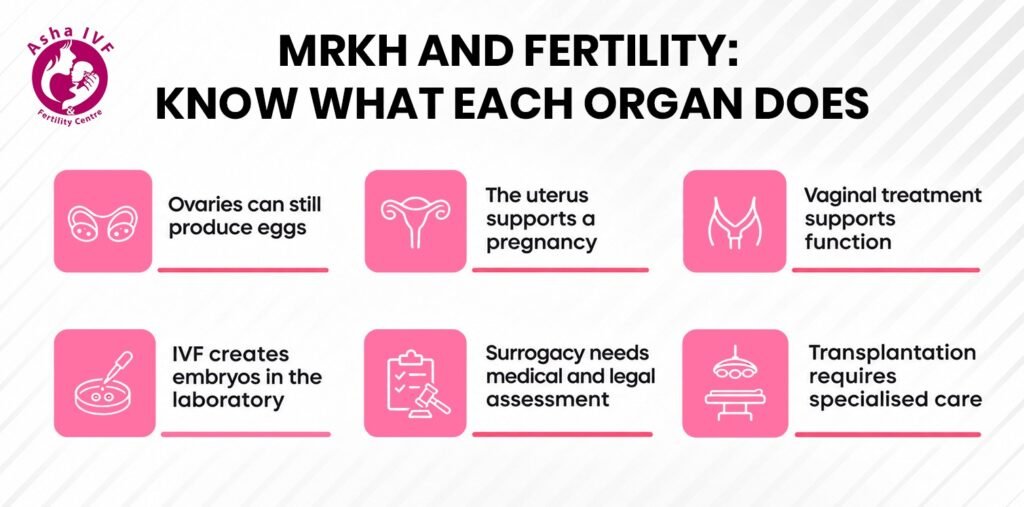
The ovaries produce eggs and reproductive hormones. The uterus provides the space where an embryo implants and a pregnancy grows. These are different functions, which explains why someone may ovulate without having menstrual bleeding.
For fertility planning, the distinction looks like this:
| Body structure | Main function | What MRKH may mean |
| Ovaries | Produce eggs and reproductive hormones | Often function, making use of the woman’s own eggs possible |
| Uterus | Supports implantation and pregnancy | Absent or insufficiently developed to carry a pregnancy |
| Vagina | Supports sexual function and access for some procedures | May be shorter; assessment and treatment depend on individual needs |
An absent period alone cannot confirm MRKH. If periods have not started by age 15, arrange a medical assessment rather than assuming the cause.
Are there different types of MRKH?
Type 1 mainly affects the reproductive tract. Type 2 also involves differences elsewhere in the body, particularly the kidneys or spine; hearing and heart differences may also occur. These findings matter for overall health and treatment planning.
Diagnosis usually involves a medical history, a sensitive examination when appropriate, ultrasound, and sometimes MRI. Blood tests, including chromosome testing, help distinguish MRKH from other conditions. Kidney assessment and further checks may be recommended.
You do not need to make fertility decisions during the same appointment that confirms the diagnosis. Ask for a clear explanation of your anatomy and copies of your reports, so future discussions start with accurate information.
What Fertility Options Are Available With MRKH Syndrome?
The main questions are whether usable eggs can be collected and who can safely and legally carry the pregnancy. Treatment should answer both before a plan is agreed.
IVF with a gestational surrogate
IVF with a gestational surrogate may allow a woman with functioning ovaries to have a child genetically related to her. Eggs are fertilised outside the body, and an embryo is transferred to the surrogate’s uterus. The surrogate carries the pregnancy and does not provide the egg in a gestational surrogacy arrangement.
The medical stages generally include:
- Fertility assessment: Review the ovaries, reproductive anatomy, relevant health conditions, and sperm factors.
- Ovarian stimulation: Use prescribed medicines and monitoring to develop eggs for collection.
- Egg retrieval: Collect eggs using a method suitable for the individual’s anatomy.
- Fertilisation and embryo development: Fertilise eggs in the laboratory and assess the resulting embryos.
- Embryo transfer: Transfer an embryo to an appropriately assessed surrogate after the necessary approvals.
MRKH can make planning egg collection more complex because the vagina or the position of the ovaries may differ. The specialist should explain whether standard vaginal access is suitable or another approach is needed. Vaginal reconstructive surgery is not automatically a prerequisite for fertility treatment.
IVF cannot guarantee a baby. Egg age, ovarian response, sperm quality, embryo development and the health of the person carrying the pregnancy all affect the outcome. Ask what each stage can establish before committing to the next.
MRKH syndrome treatment in India: where does Altruistic surrogacy fit?
India permits regulated altruistic surrogacy and prohibits commercial surrogacy. The absence of a uterus is a recognised medical indication, but an MRKH diagnosis alone does not establish legal eligibility.
Requirements also concern the intending parents, the surrogate, medical certification and approvals. Eligibility can depend on age, marital and citizenship status, existing children and the applicable statutory provisions. A registered clinic and qualified legal adviser should review the current requirements for your circumstances before treatment proceeds.
If donor eggs are being considered, medical need and legal permission must both be assessed. Under the 2024 amendment, an intending couple may use a donor gamete when the District Medical Board certifies a medical condition requiring it, provided the child has at least one gamete from the intending couple. Separate provisions apply to an eligible intending woman.
For someone with MRKH whose own eggs are usable, donor eggs are not automatically necessary. Nor should a surrogacy package be treated as confirmation that all legal conditions have been met.
Can a uterus transplant help a woman carry a baby?
A successful uterus transplant can make carrying a pregnancy possible for selected women with uterine factor infertility. Births have occurred after transplantation, but this is a complex pathway available through specialised programmes with strict selection criteria. It should not be presented as routine MRKH care.
Treatment involves more than transplant surgery. It generally requires IVF, medicines that suppress the immune system, monitoring for rejection, and specialist pregnancy care. Delivery is by caesarean section. The transplanted uterus is usually removed after the planned pregnancy or pregnancies, so immunosuppressive treatment can end.
Access, donor arrangements, suitability and programme experience need separate investigation. A general fertility consultation does not establish eligibility for transplantation, and this article does not imply that Asha IVF provides it.
Egg freezing and other family-building choices
If you want to preserve eggs while postponing decisions about parenthood, ask whether egg freezing is appropriate for your age, ovarian function and anatomy. Freezing eggs preserves a possible future resource; it does not provide a uterus, guarantee a baby, or establish future surrogacy eligibility.
Adoption is another route to parenthood, subject to the relevant eligibility and legal process. It does not require fertility treatment. Some women also choose to delay family-building decisions or not pursue parenthood. Counselling should leave room for each of these choices.
What Does MRKH Syndrome Treatment Involve Beyond Fertility?
MRKH syndrome treatment addresses the concerns that matter to the individual, including vaginal function, pain, associated health conditions, and emotional wellbeing. Fertility planning is one part of that care.
Can treatment create a uterus or restore periods?
Medicines and vaginal dilation do not create an absent uterus. Surgery to create or lengthen a vagina also does not create a womb or restore the ability to carry a pregnancy. This distinction helps prevent misleading expectations about what reconstructive treatment can achieve.
For someone who wants treatment for a shortened vagina, supervised vaginal dilation is usually the first approach. It gradually stretches existing vaginal tissue using specially designed dilators. Surgery may be considered in selected circumstances after counselling. Treatment should reflect the person’s readiness and preferences.
What if there is monthly pain despite no bleeding?
Some women have small uterine remnants containing functioning lining. These can contribute to recurring pelvic pain, including when blood cannot drain normally. Pain needs assessment rather than being dismissed because periods are absent. Management depends on the scan findings and identified cause.
What should you ask at a fertility consultation?
Bring previous scans, MRI reports, blood tests, and records of any surgery. Useful questions include:
- Do my reports clearly identify my ovaries and uterine anatomy?
- What assessment is needed before deciding whether to use my own eggs?
- How would eggs be collected safely in my case?
- Are associated kidney or other health findings relevant to treatment?
- Which medical and legal conditions need to be met before surrogacy?
- Which costs relate to testing, medicines, egg retrieval, storage and later treatment?
Ask for an itemised estimate based on the proposed plan. A single advertised figure may not explain which stages are included or what happens if further treatment is needed.
Emotional support belongs in the treatment plan
A diagnosis can affect how you feel about your body, intimacy and future relationships. You may feel grief, uncertainty or pressure to make decisions quickly. These reactions deserve attention alongside scans and fertility tests. Specialist counselling and peer support can help, and you can decide whether a partner or family member joins discussions.
Make Your Next Decision With Clear Information
Having MRKH does not mean every route to parenthood is closed. It does mean that answers about eggs, pregnancy and treatment need to be considered separately. Your scans, ovarian assessment, wider health and personal circumstances should shape the discussion, rather than a general promise that IVF will solve everything.
If you are ready to explore fertility options, book a consultation with Asha IVF to discuss your reports, the questions that need answering and the assessments relevant to your situation. The aim of that first conversation should be clarity about your next step, including any specialist or legal input required.
You may be ready to plan treatment, or you may need more time. Either way, you deserve an explanation you understand and decisions made at a pace that feels manageable.

FAQs
1. Can a woman with MRKH syndrome get pregnant naturally?
Without a functioning uterus, she cannot carry a natural pregnancy. Ovaries may still produce eggs, which can sometimes be used for IVF with a gestational surrogate where legally permitted. Uterus transplantation is a separate specialised pathway.
2. Do all women with MRKH need donor eggs?
No. Many have functioning ovaries and may use their own eggs. Donor eggs are considered only when medically appropriate, with separate legal requirements if surrogacy is involved.
3. Does vaginal surgery make pregnancy possible?
Vaginal surgery can address vaginal length or function, but it does not create a uterus. It therefore does not, by itself, make carrying a pregnancy possible.
4. Can women with MRKH have a comfortable sex life?
Many can, with care tailored to their anatomy, comfort and preferences. Some choose dilation or surgery; counselling and sexual-health support may also help. Treatment should not be imposed or rushed.
5. Is MRKH syndrome inherited by a baby conceived using my eggs?
Inheritance is not straightforward. Most cases occur without a family history, although familial cases exist. Genetic counselling can discuss known findings and uncertainty; routine embryo testing cannot guarantee that a child will not have MRKH.
6. Does MRKH mean my ovaries will stop working early?
MRKH mainly affects development of the uterus and upper vagina and does not automatically mean ovarian failure. Ovarian function needs individual assessment, particularly when planning egg retrieval or preservation.
7. What is the cost of MRKH syndrome treatment in India?
There is no single treatment or standard cost. Assessment, dilation, surgery, IVF, and fertility preservation involve different expenses. Request an individual plan and itemised estimate; surrogacy also requires a separate eligibility review.
8. Is there a guaranteed IVF success rate for MRKH?
No. An MRKH diagnosis alone cannot predict a live birth. The specialist must consider egg age, ovarian response, sperm, embryos and the person carrying the pregnancy when discussing realistic expectations.