
For many couples, starting IVF brings one wish into focus: “Let this be the attempt that works.” After months of waiting and uncertainty, it is natural to look for a number that offers reassurance. However, an IVF success rate needs context before it can help you understand your own chances. Your age, fertility diagnosis, embryo development, and the way a clinic measures success all influence what that percentage means.
This guide explains how to interpret IVF outcomes, why treatment may not work the first time, which factors matter most, and how a personalised evaluation can help you approach the next step with realistic expectations.
Understanding What an IVF Success Rate Really Means
The IVF success rate is the proportion of treatments that achieve a defined outcome, such as clinical pregnancy or live birth. It varies between patient groups and cannot predict an individual result with certainty.
So, what is the success rate of IVF? The useful answer depends on whose treatment is being measured and whether the figure refers to a cycle started, an embryo transfer, or several attempts combined.
| Success-rate measure | What it means | What couples should check |
| Clinical pregnancy rate | Pregnancy confirmed clinically, usually by ultrasound | This is not the same as a live birth |
| Live birth rate | Treatment resulting in at least one baby born alive | Whether results match your age and egg source |
| Rate per cycle started | Outcomes among patients beginning a treatment cycle | Includes those who never reach transfer |
| Rate per embryo transfer | Outcomes among patients receiving an embryo transfer | Excludes cycles that stop before transfer |
| Cumulative live birth rate | Birth outcomes across a defined series of treatments | Number of retrievals, transfers, and follow-up period |
For context, the UK regulator HFEA reported an average IVF birth rate of 30% per embryo transferred in 2024. This is a UK population figure, not an Indian clinic benchmark or a prediction for you.
Why IVF May Not Work on the First Attempt?
An unsuccessful first IVF attempt does not automatically mean future treatment will fail. IVF involves several biological stages, and difficulties can arise before fertilisation, during embryo development, or after transfer.
Possible reasons include:
- Limited ovarian response: Fewer mature eggs may be available for fertilisation.
- Fertilisation difficulties: Egg or sperm factors may affect embryo formation.
- Embryo abnormalities: Chromosomal problems may prevent implantation or contribute to miscarriage.
- Uterine conditions: Certain polyps, fibroids, or adhesions may affect the uterine cavity.
- Lining or hormone concerns: Endometrial development or progesterone timing may need review.
Sometimes, no single explanation can be identified. A failed transfer alone does not prove that the uterus has a problem or that additional tests are necessary.
A cycle review helps identify whether a relevant adjustment is possible. However, another attempt does not automatically have a higher success rate. Cumulative chances can rise through additional opportunities, including frozen embryo transfers, but cycle percentages should never simply be added together.
Factors That Affect IVF Success Rate
IVF outcomes reflect several factors working together. Understanding them helps couples ask more useful questions than whether a clinic advertises a high percentage.
Age and egg source
Age is particularly important when using your own eggs because chromosomal abnormalities become more common as eggs age. HFEA’s 2024 UK figures reported birth rates per embryo transferred of 38% at ages 18–34 and 8% at ages 43–44. These population averages illustrate the age-related difference; they do not determine an individual outcome.
For donor-egg IVF, the donor’s age is more relevant to embryo-related prospects, while the recipient’s health remains important. Discuss IVF success rate after 40 in relation to your egg source and treatment history.
Ovarian reserve and sperm health
AMH and antral follicle count help estimate ovarian response and potential egg yield. Low AMH does not directly mean poor egg quality or rule out pregnancy. Semen analysis assesses sperm count, movement, and shape; further investigations depend on the findings and history.
Embryo development and uterine health
Embryo grading assesses appearance and development, but a good grade cannot guarantee normal chromosomes or implantation. A thin endometrium or a suspected uterine abnormality needs interpretation alongside the cycle stage, scan findings, and clinical history.
General health and treatment quality
Stopping smoking, reviewing medicines, and managing existing health conditions support preparation. Discuss supplements with your clinician rather than starting products advertised to improve fertility. Emotional support matters, but an unsuccessful cycle should never be blamed on a patient’s feelings.
Laboratory standards and appropriate treatment decisions also matter. Extra technology is not automatically beneficial: routine PGT-A, which screens embryo samples for chromosome-number abnormalities, has not demonstrated value for every IVF patient. Ask why an additional procedure is recommended for your case.
Asha IVF: Helping You Look Beyond the Numbers
Every IVF percentage tells only part of the story. At Asha IVF, your medical history, fertility evaluation, and previous treatment response help shape a plan around you. Whether you are starting IVF or considering another attempt, the discussion focuses on:
- Understanding both partners’ fertility and suitable treatment options.
- Reviewing previous cycles to identify whether changes are appropriate.
- Explaining realistic chances, treatment limitations, costs, and next steps.
Seek evaluation after 12 months of trying if under 35, or six months at 35 or older. Above 40, or with irregular periods or known fertility concerns, seek guidance sooner. The goal is to move forward with clearer answers and informed choices.
Making IVF Decisions With Clearer Expectations
An IVF success rate is most useful when it helps you ask informed questions, rather than creating pressure to achieve pregnancy immediately. Look beyond headline percentages and understand the outcome measured, the patient group, and the number of attempts included. Your own treatment prospects need an assessment of age, diagnosis, egg source, and previous response.
At Asha IVF, a consultation can help you discuss these factors and explore relevant fertility care. Whether you are preparing for your first cycle or considering another attempt, aim for a plan grounded in clear explanations, realistic expectations, and informed choices.

FAQS
What is the average IVF success rate in India?
There is no single rate that applies to every clinic or patient. Ask for verified live birth results matching your age and egg source.
How does age affect the IVF success rate?
IVF success generally declines with age when using your own eggs. With donor eggs, the donor’s age plays a greater role in embryo-related outcomes.
Can IVF succeed in the first attempt?
Yes, IVF can succeed in the first attempt, but it is not guaranteed. Your chances depend on your age, diagnosis, and egg, sperm, and embryo factors.
How can I assess a fertility clinic’s IVF success rate claims?
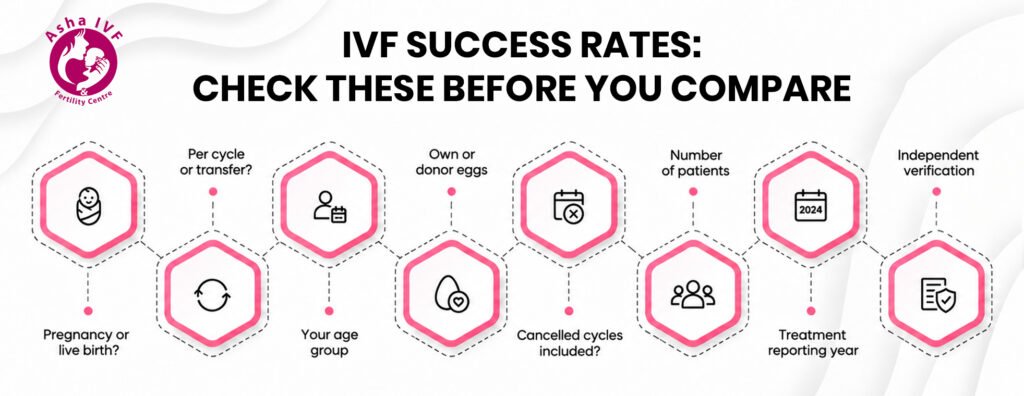
Check the outcome measured, age group, egg source, reporting year, and verification. Compare live birth rates calculated on the same basis.
How can I book an IVF success evaluation at Asha IVF?
Request a consultation through Asha IVF’s website. Bring previous fertility reports and treatment records to discuss your individual prospects and options.