

You’ve booked your first pregnancy check-up and spotted a TORCH test in a lab package. Should you add it? If you feel well, have a low-risk pregnancy, and have had no known exposure or concerning scan findings, you usually don’t need the full TORCH panel. Indian obstetric guidance recommends investigating specific infections when there’s a clinical reason.
That reason might be a rash after contact with someone who has an infection, an unexpected ultrasound finding, or an antibody result that needs a second look. The most helpful question to ask your doctor is which infection they suspect and how the result would change your care.
What Does the TORCH Test Check For?
A TORCH test is a group of blood tests for infections that can affect a pregnancy or a newborn. You may see it listed as a TORCH profile test or a TORCH panel test. Most panels look for antibodies your body makes after exposure. The exact infections and antibody types included depend on the laboratory and the tests your doctor orders.
| Letter | Infection | Why it matters in pregnancy |
| T | Toxoplasmosis | A first infection during or shortly before pregnancy can pass to the baby. Exposure can occur through undercooked meat or contact with contaminated soil or cat litter. |
| O | Other infections | This category varies. Syphilis and parvovirus B19 are examples, but a lab package may leave them out or list them separately. |
| R | Rubella | Rubella can cause serious problems for a developing baby, especially early in pregnancy. Rubella IgG can help assess immunity. |
| C | Cytomegalovirus (CMV) | CMV often causes few or no symptoms in adults. A baby born with CMV can develop hearing loss or other health problems. |
| H | Herpes simplex virus (HSV) | Genital herpes is especially relevant to delivery planning. The risk to the newborn is highest when the mother first acquires genital herpes close to delivery. |
If your doctor asks for a single rubella IgG test, the question may simply be whether you have immunity. If they suspect a recent CMV infection, they may order CMV-specific tests and compare your results with an earlier sample. The lab’s package name tells you less than the individual tests on the request form.
When Might Your Doctor Recommend Testing?
After symptoms or a possible exposure
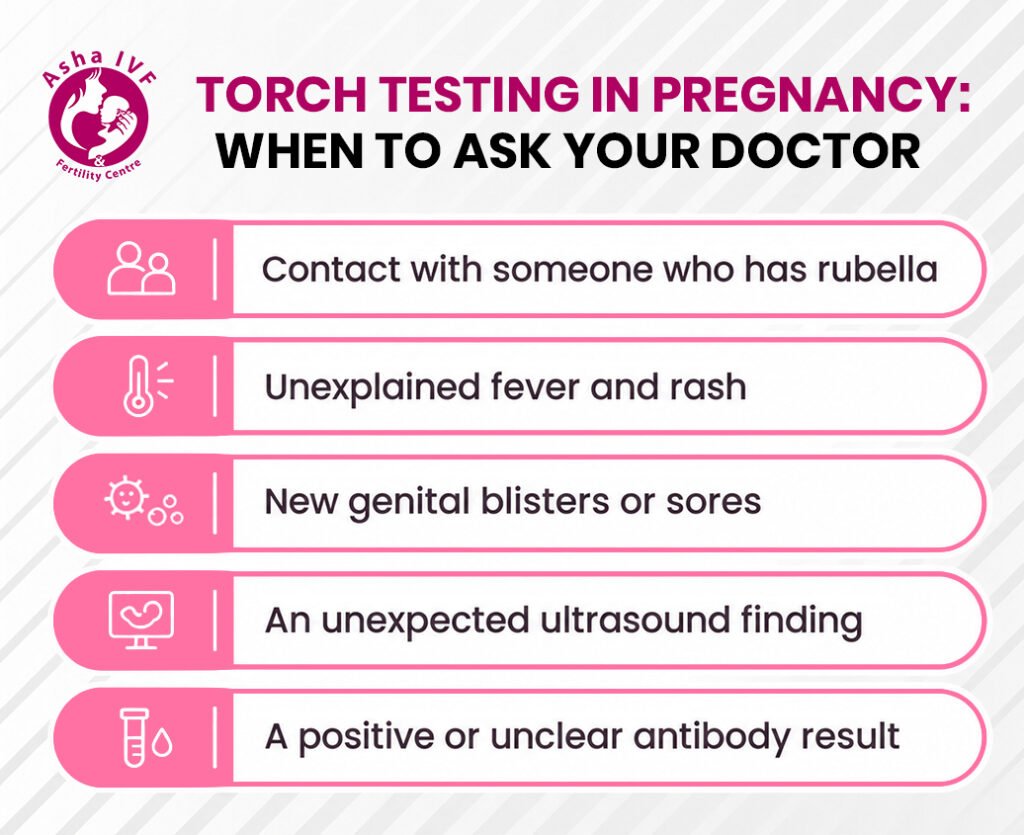
Tell your obstetrician promptly if you develop an unexplained rash with fever or learn you were in close contact with someone who has rubella or another infection that can matter in pregnancy. Exposure can be relevant even if you feel well. If you develop new genital blisters or sores, contact your maternity team promptly, especially later in pregnancy. They may want to examine you and take a swab.
Give your doctor the date of the contact, when your symptoms began, and how far along you are. If someone else in your household has symptoms, mention that as well. Those details can help them decide which test to order and whether you need an initial sample followed by another one later. If a child in your household has a rash, the name of any confirmed infection is more helpful than a description of the rash alone.
A test ordered immediately after contact can provide a starting point for comparison. Antibodies may take time to show up, so a negative result soon after an exposure may need follow-up. Your obstetrician can use the date of contact to decide when a repeat sample would be informative. If you have past reports for the same infection, share those too. They may already answer part of the question your doctor is investigating.
When an ultrasound raises a specific concern
Your obstetrician may investigate an infection if an ultrasound shows unexpected findings, such as a baby growing more slowly than expected alongside other signs, or unusual fluid build-up. Several conditions can cause similar findings. The scan may lead to targeted blood tests, a detailed follow-up scan or a referral to a fetal medicine specialist. The next step depends on the overall pattern and how far along you are.
After a miscarriage or before fertility treatment
A previous miscarriage can make a long list of tests feel reassuring. For repeated pregnancy loss, Indian standard treatment guidance advises against using TORCH investigations as a routine work-up. Your clinician can review when the losses occurred, your scan findings and your medical history to choose an appropriate evaluation. Depending on your history, that may include assessment of the shape of the uterus or selected blood tests. If your doctor raises a concern about the uterine cavity, you can read more about hysteroscopy and when it may be considered.
If you’re having fertility testing as a couple, ask which tests address your chances of conceiving and which check your health before pregnancy. If you’re preparing for IVF treatment, your clinic may request specific infection screens as part of treatment preparation. Ask which infections they’re checking for and what each result will be used for.
For example, if you’re preparing for treatment and your rubella vaccination history is unclear, ask whether checking rubella immunity would help you plan. That conversation is best had before pregnancy, when vaccination is still an option. Bring any childhood or adult vaccination records you can find to your appointment.
How does TORCH testing fit into routine antenatal care?
Keep the blood tests and scans your obstetrician recommends as part of routine pregnancy care. Screening for infections such as HIV, hepatitis B and syphilis has its own role. Your doctor can explain when those tests are due. If a lab package includes TORCH, ask your doctor which items you need for routine care and which would be useful only if a specific concern comes up.
How to Read a TORCH Test Report
A TORCH report often lists IgG and IgM next to the name of each infection. These are different types of antibodies. Your doctor interprets them alongside the organism tested, your pregnancy dates, any symptoms or exposure, and earlier results.
| Finding | What it may mean | What to ask your doctor |
| IgG positive, IgM negative | Often reflects past exposure. For rubella, a positive IgG may indicate immunity from vaccination or past infection. | Does this result answer the question we were testing for? |
| IgM positive, with or without IgG | May suggest recent infection. IgM can also remain detectable after an older infection or give a false positive. | Do I need a confirmatory test or a repeat sample? |
| IgG and IgM both negative | The sample contained no detectable antibodies. A very recent infection can be missed before antibodies appear. | Given the date of my exposure, should I repeat the test? |
A rubella IgG result labelled “positive” can be reassuring if you were checking immunity. A positive CMV IgM, on the other hand, needs more context. Your doctor may compare it with an older sample, order another blood test or request an IgG avidity test. Avidity measures how strongly IgG antibodies bind and can help estimate whether certain infections, such as CMV, are likely to be recent.
When a maternal result raises concern about infection in the baby, a specialist may recommend additional assessment. For suspected congenital CMV, that can include testing a sample of amniotic fluid. The timing depends on both the stage of pregnancy and when the maternal infection is thought to have occurred. Ask your doctor what the next test can clarify and when you can expect an answer.
What if two labs flag the same result differently?
A result near the lab’s threshold may be reported as borderline or equivocal. Different assays can use different cut-offs, so a number on one report may be hard to compare with a number from another lab. Show your doctor both reports, including the sample dates and reference ranges. If the plan is to look for a change over time, ask whether the repeat sample should go to the same lab. Your doctor may also use a different method to confirm an unexpected result.
Take the report and your dates to your next appointment
If a lab has flagged a result, bring the full report, any previous results, your vaccination record if available, and the date of any possible exposure. If you’re already pregnant and have a new exposure or symptoms, call your obstetrician promptly so they can advise you on timing.
If you’re planning a pregnancy after a loss or preparing for fertility treatment, you canbook a consultation with Asha IVF to discuss which tests fit your history. You can check the Faridabad fertility centre and Gurgaon clinic contact details before arranging a visit.
Before you leave the appointment, ask which result matters now, whether you need another sample, and when to expect a clearer answer. If a follow-up test is planned, write down the date and ask whom to call if you develop symptoms before then. Having those details in one place can make the wait easier.

Frequently asked questions
1. In which month of pregnancy is a TORCH test done?
There’s no set month for the full panel. When your obstetrician suspects an infection, the timing depends on your symptoms, exposure or ultrasound findings. Call promptly after a known exposure so your doctor can advise when the first sample should be taken.
2. Do I need to fast before a TORCH profile test?
Fasting generally isn’t required for TORCH antibody testing. Check with the lab if you’re giving blood for other tests at the same appointment, since some of those may have different preparation instructions.
3. Does a positive TORCH test mean my baby has an infection?
A positive maternal antibody result tells your doctor something about your immune response. Whether the baby could be affected depends on the infection, when it occurred and what follow-up testing shows. Your obstetrician can explain whether a fetal medicine review is needed.
4. What if my report says I have no rubella immunity?
If you’re planning a pregnancy, ask your doctor about the MMR vaccine. After receiving it, wait at least 28 days before trying to conceive. If you’re already pregnant, discuss what to do after a possible exposure and arrange vaccination after delivery if advised.
5. Can I lower my risk of CMV if I have a toddler at home?
Yes. Wash your hands with soap and water after changing nappies or helping your child use the toilet. Avoid sharing cups, spoons or food with young children to reduce contact with saliva. These everyday precautions are practical even when a child seems well.
6. Does having a cat mean I need a toxoplasmosis test?
Owning a cat alone doesn’t mean you need testing. Ask someone else to change the litter if possible. If you must do it, wear gloves and wash your hands afterwards. Cooking meat thoroughly and washing fruit and vegetables also help reduce the risk of toxoplasmosis.
7. Should I repeat a TORCH panel every trimester?
Routine repeat panels are generally unnecessary in a low-risk pregnancy. If a specific infection is suspected or a result is unclear, your doctor may repeat the relevant test after a suitable interval. Ask which marker they’re following and why the timing matters.