
These days, more women are choosing to start families later in life. This change is often due to career goals, personal situations, or waiting for the right partner. If you are over 40 and considering IVF, you are not alone, and your questions are important.
The good news is that IVF after 40 is possible, and thousands of women have had success with it. Still, age does play a role in fertility. Learning how this affects you is the first step to making a choice that feels right for you.
This guide will explain what you need to know about IVF after 40. You will learn about success rates, what to expect during treatment, when donor eggs might be a good option, and how to pick the right fertility center for your needs.
Key Overview
- IVF after 40 can work, but success depends on egg quality, uterine health, and treatment approach.
- Success rates: 20–25% (age 40–42) and 5–10% (43+); donor eggs can increase it to 50–60%.
- Donor eggs are considered if AMH is low, egg quality is poor, or previous IVF cycles have failed.
- Key tests include AMH, AFC, FSH, estradiol, and a detailed uterine evaluation.
- Asha IVF offers age-specific protocols, PGT testing, and expert care under Dr. Astha Chakravarty.
Why Does Fertility Decline After 40?
Fertility does not switch off at 40, but it does change considerably. Here is what happens biologically, and why it matters for IVF planning.
Egg Quality Decreases with Age
As women age, the eggs they produce are more likely to carry chromosomal abnormalities. This makes it harder for a healthy embryo to form and increases the risk of miscarriage. This is one of the most significant factors affecting IVF success after 40.
Ovarian Reserve Drops Significantly
Women are born with all the eggs they will ever have. AMH (Anti-Mullerian Hormone) is a key marker that reflects how many eggs remain. After 40, AMH levels often drop considerably, which is described as low ovarian reserve. Fewer eggs mean fewer chances per cycle.
Hormonal Regulation Becomes Less Predictable
Hormonal fluctuations that govern ovulation can become irregular with age, making it harder to time natural conception and requiring closer monitoring during IVF stimulation.
Pre-existing Conditions May Play a Role
Conditions such as endometriosis, uterine fibroids, or PCOS may become more prominent with age and can affect both natural fertility and IVF outcomes. A thorough evaluation before starting treatment is essential.
IVF Success Rate After 40: What the Data Shows
IVF success after 40 varies depending on several factors. Here is a realistic picture based on widely reported clinical data.
- Women aged 40-42 using their own eggs: approximately 20-25% success rate per cycle
- Women aged 43 and older using their own eggs: approximately 5-10% success rate per cycle
- Women using donor eggs: success rates typically range from 50-60% per cycle, regardless of the recipient’s age
These are general population figures. Your individual results will depend on your ovarian reserve, egg quality, uterine health, the quality of sperm used, and the expertise of the fertility team managing your cycle.
It is also worth noting that IVF success rates are typically reported per cycle, not per person. Many women over 40 require more than one cycle. An experienced IVF specialist in Faridabad or Delhi NCR can assess your specific profile and give you a more personalised estimate.
What to Expect in IVF After 40
IVF after 40 follows the same general steps as for younger women, but with some important adjustments.
Step 1: Initial Fertility Assessment
Before starting, your doctor will evaluate your AMH levels, antral follicle count (AFC), FSH, estradiol, and uterine anatomy. These fertility tests for women over 40 help determine the best protocol for your cycle.
Step 2: Ovarian Stimulation
Fertility medications are used to stimulate the ovaries to produce multiple eggs. Women over 40 with low ovarian reserve may require higher doses or modified protocols to maximize the response.
Step 3: Egg Retrieval
Once the follicles reach maturity, eggs are retrieved through a minor surgical procedure under sedation. The number of eggs retrieved may be lower than in younger patients, which is expected.
Step 4: Fertilisation and Embryo Development
Retrieved eggs are fertilised with sperm in the laboratory. Embryos are then monitored over several days. At Asha IVF & Fertility Centre in Faridabad, advanced embryology lab conditions support healthy embryo development.
Step 5: Genetic Testing (PGT)
For women over 40, Preimplantation Genetic Testing (PGT) is often recommended. PGT screens embryos for chromosomal abnormalities before transfer, which can significantly reduce miscarriage risk and improve the likelihood of a successful pregnancy.
Step 6: Embryo Transfer
The healthiest embryo is selected and transferred into the uterus. A two-week wait follows before a pregnancy test confirms the outcome.
IVF with Donor Eggs After 40: When Is It the Right Choice?
Using donor eggs is one of the most effective options available to women over 40 who are facing significant fertility challenges. If your own eggs are no longer producing viable embryos, donor eggs offer a meaningful path forward.
Who Should Consider Donor Eggs?
- Women with very low AMH or severely reduced ovarian reserve
- Women who have had multiple failed IVF cycles using their own eggs
- Women where PGT has shown consistent chromosomal abnormalities in retrieved embryos
- Women aged 43 or older where own-egg success rates are significantly diminished
Donor eggs come from younger, thoroughly screened donors. Because the egg quality is typically much higher, success rates with IVF and donor eggs after 40 are considerably better, often comparable to those of a woman in her late 20s or early 30s.
The decision to use donor eggs is personal and can carry emotional weight. Dr. Astha Chakravarty and the team at Asha IVF approach this conversation with sensitivity and provide the support needed to make an informed decision that feels right for you.
How to Maximize IVF Success Rate After 40
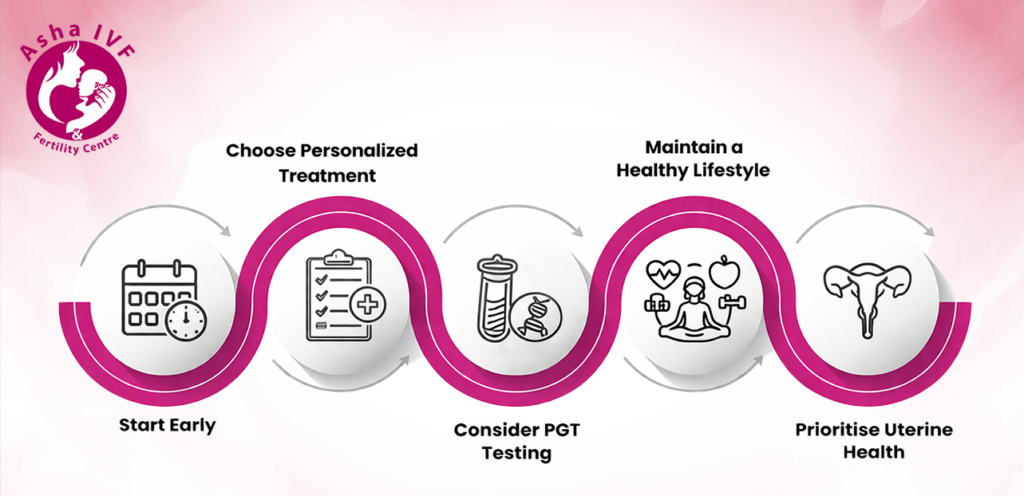
While age is a significant factor, there are steps you can take to give yourself the best possible chance.
Conclusion
IVF after 40 is a real option, and for many women, it is the path that leads to a successful pregnancy. It requires honest conversations, thorough testing, and a fertility centre that takes a personalised, experienced approach.
Understanding your fertility tests, knowing your IVF timeline after 40, and working with a specialist who understands the nuances of treating women in this age group makes a meaningful difference. Whether you choose to proceed with your own eggs or explore IVF with donor eggs after 40, the journey is yours to navigate with the right support behind you.
If you are in Faridabad, Gurgaon, or anywhere across Delhi NCR, and you are ready to take the first step, Asha IVF & Fertility Centre is here to help. Dr. Astha Chakravarty and the team will walk with you through every stage of the process with clarity, care, and clinical precision.

FAQ
1. Is IVF successful after 40?
Yes, IVF can be successful after 40, though success rates are lower than in younger age groups. Women aged 40-42 typically see a 20-25% success rate per cycle using their own eggs. With donor eggs, success rates improve significantly, often reaching 50-60% per cycle. Individual results depend on ovarian reserve, egg quality, uterine health, and the treatment protocol used.
2. What is the IVF success rate after 40 in India?
IVF success rates in India for women over 40 are broadly consistent with global data. Using own eggs, rates generally fall between 15-25% for women aged 40-42 and drop further after 43. With donor eggs, rates are considerably higher, often between 50-60% per cycle. These figures vary by clinic, lab quality, and individual patient profile.
3. Should I consider donor eggs for IVF after 40?
Donor eggs are worth considering if your AMH levels are very low, your ovarian reserve is severely diminished, or previous IVF cycles with your own eggs have not been successful. Donor eggs come from younger, screened women and offer significantly better success rates. This is a personal decision; your fertility specialist can guide you based on your test results and clinical history.
4. What tests are required before starting IVF after 40?
Before starting IVF after 40, essential tests include AMH (Anti-Mullerian Hormone) to assess ovarian reserve, Antral Follicle Count (AFC) via ultrasound, FSH and estradiol blood tests, and a uterine evaluation. A semen analysis for your partner is also required. These tests help your doctor design the most appropriate treatment protocol for your situation.
5. How many IVF cycles should a woman over 40 attempt?
There is no universal answer. Typically, fertility specialists evaluate outcomes after each cycle before recommending continuation. Most women are advised to attempt two to three cycles before reassessing the approach, including the possibility of donor eggs. Your specialist will factor in your response to stimulation, embryo quality, and overall health when advising on next steps.